Card line one · front to back, side to side
Rotate the Routine
A tire that does the same job on every mile wears a groove into itself. So does a week that runs on the same rails from Monday to Sunday.
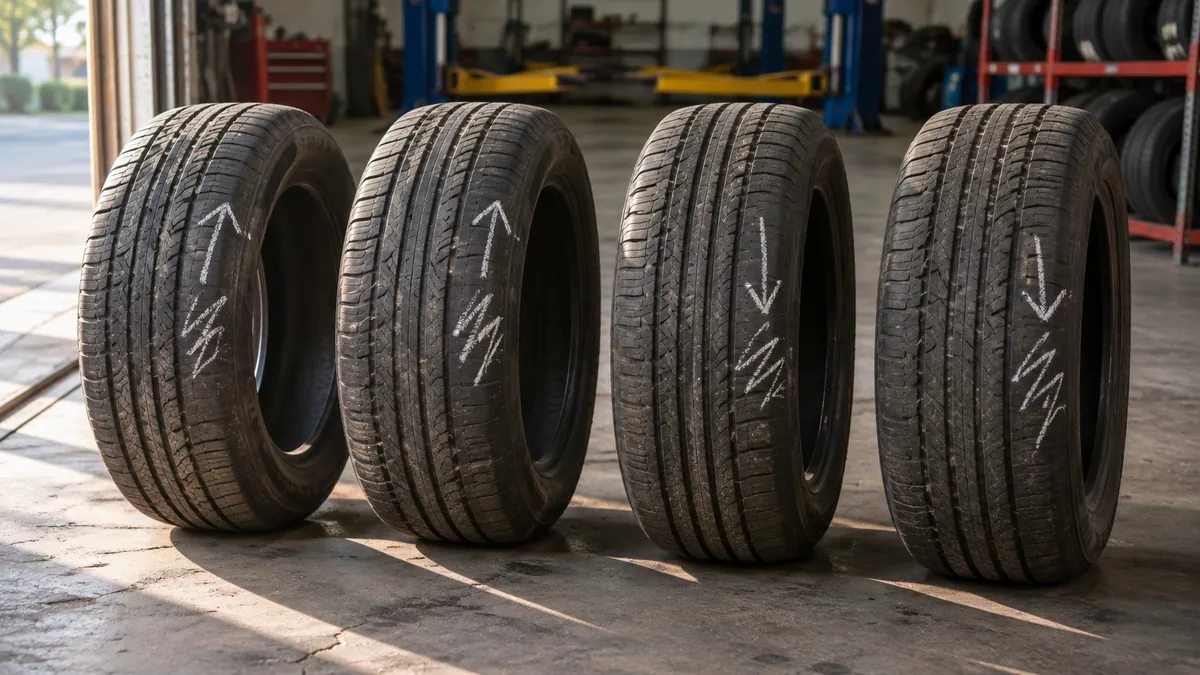
What we see on the lift
When a car rolls onto the lift for a rotation, the first thing anyone in the bay does is run a hand across the tread. The fronts usually tell a story before the gauge does. They steer, they take most of the braking, they lean into every turn out of the parking lot, and so the outer edges go soft and rounded while the center still looks fine. The rears, which mostly follow along, wear flatter and slower. Leave them where they are for long enough and the set ends up mismatched: two tires tired, two tires barely used, and a car that pulls a little in a direction the driver stopped noticing months ago.
The fix for that, in the plain mechanical sense, is boring. Swap them. Fronts go back, rears come forward, and on most passenger cars they cross sides on the way, which is why the card we hand back has the X drawn on it. Done every few thousand miles, rotation spreads the work around so that no single tire carries the whole load of habit. Nobody needs a new set. The same four rubber circles simply take turns at the hard job.
Where a routine wears thin
People who have been driving for forty years tend to have the drive to the market memorized so well that they arrive with no recollection of the trip. That is not a failing; it is the brain being efficient, handing a familiar job to autopilot and saving its attention for something else. The trouble starts when almost the whole day goes onto autopilot. Same chair at the same window. Same three channels. Same route to the same store at the same hour. The mind gets very good at a very narrow path, and the shoulders of the day go soft while the middle stays untouched.
Plenty of drivers with grey at the temples put the feeling in nearly identical words: weeks that blur, afternoons that leave no trace, the sense of having been somewhere without having noticed being there. Researchers who study attention have spent a long time on novelty, on how new places and new tasks seem to call more of the mind into the room. The findings are not a promise, and they are not a prescription. They do line up with what any shop foreman would guess, which is that a part used in only one way tends to wear in only one way.
The rotation, applied to a week
At the shop the rotation is written down so nobody has to remember it. The same trick works at home. Take a sheet of paper and draw four boxes, one for each corner of an ordinary week: the morning, the errands, the afternoon, the evening. In each box write the thing you always do there. Then, once a week, move one of them.
Some swaps are tiny and still count. Drive to the pharmacy by the road you never take, and actually look at what is on it. Sit on the other side of the kitchen table for breakfast. Do the dishes before the coffee instead of after. Put the reading glasses in the left pocket for a week. None of this is meant to be a test. It is meant to hand the steering back to the person in the seat for a few minutes at a time.
Other swaps are bigger and come around less often, the way a full balance and alignment does. Once a season, pick up one small skill you do not have. A short list of words in another language, practiced while the kettle heats. A card game with rules you have to look up. A dozen chords on a borrowed guitar. A new walking loop through a part of town you only know from the car window. The point is not mastery. The point is that, for a while, the familiar groove is not enough to get through the task, and the head has to show up for it.
Keep the card in the glovebox
The rotation card we give customers has dates on it for a reason. Good intentions about tires last about as long as the drive home. Writing the next swap on the card, and leaving the card where it will be seen, is what makes it happen. A paper list on the refrigerator does the same job for a routine. Write down this week's swap, cross it off when it is done, and write next week's below it. After a couple of months the list itself becomes a small record of a season in which the days were not all the same day.
Two cautions from the bay. First, rotation does not fix a bent rim or a worn suspension; if something is actually wrong with the car, moving the tires around only hides it for a while. Second, a rotation done in a hurry, with lug nuts left loose, is worse than none. The same goes here. Changing routines is a pleasant habit, not a repair. And any new walk, new route or new activity should be one you can do safely, at a pace that suits your body.